

Most business owners aren’t asking whether to use AI anymore. They’re asking how to use it — what’s worth trying, what tasks or processes to hand over, and what to keep doing themselves. Those are real questions, and they deserve real answers.
So, this piece breaks down why so many AI rollouts crash before they start, where AI genuinely helps a business like yours day to day, and what it looks like to keep a human hand on the wheel the whole way through.
What 95% of Businesses Get Wrong About AI (and What the Other 5% Do Differently)
If a product failed 95% of the time, would you still trust it? Probably not.
Enterprise AI pilots fail at almost exactly that rate. After reviewing 300 AI initiatives and surveying over 150 executives, MIT’s NANDA initiative found 95% produce no measurable return.
 But this eye-popping number isn’t because the technology doesn’t work. It’s because all those businesses made a similar mistake.
They dove headfirst into the AI pool without reading the signs and hit bottom. They jumped over strategy and planning and ran straight to adoption, skipping the guardrails companies normally build around a transformation this size.
MIT’s researchers found the real culprits were rarely the tools themselves. Teams chased trends without defined business problems to solve.
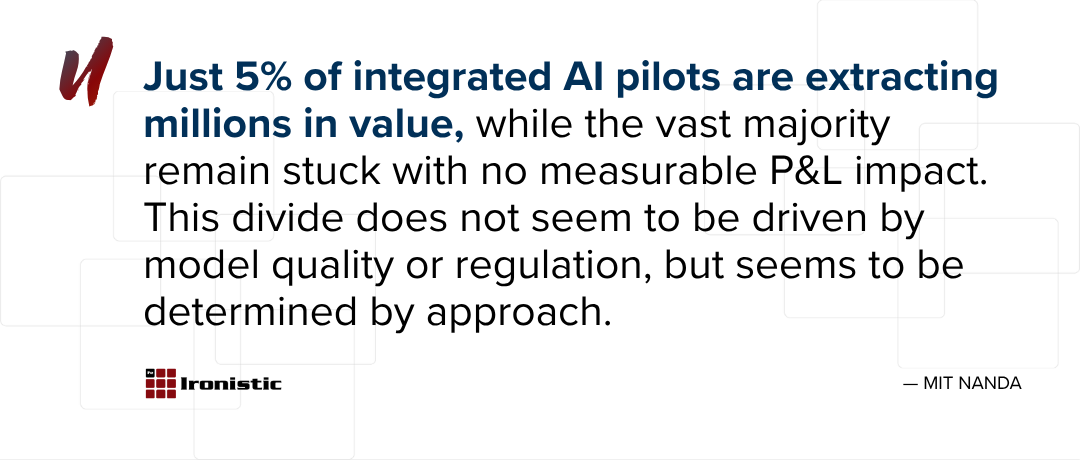
“Just 5% of integrated AI pilots are extracting millions in value, while the vast majority remain stuck with no measurable P&L impact. This divide does not seem to be driven by model quality or regulation, but seems to be determined by approach.”
— MIT NANDA
Half or more of AI budgets flowed toward flashy sales and marketing pilots instead of the back-office, daily-grind fixes that truly pay off. New tools got bolted onto instead of into old workflows while people fumbled with the controls.
It’s not all doom and gloom though. There’s a bright spot nestled in the same data: Businesses that brought in outside expertise to help plan the rollout succeeded at more than double the rate of the ones who tackled it entirely in-house (67% versus 33%).
The smart move isn’t full speed or a dead stop. It’s a clear, reasoned plan before any AI tool gets the green light.
How AI Can Help B2B Businesses Like Yours
So, lesson learned. Don’t press play on the shiny new toy without reading the instructions first. But once the strategy part’s handled, AI can earn its keep in some very real ways.
Six Everyday Wins
Campaign ideation.
A marketing team runs a dozen headlines and campaign directions past AI in an afternoon, keeps the one or two that meet the goals and still sound like the brand, and goes from there.
Research.
A day of competitor and market research gets synthesized into a working summary in about an hour, freeing that day for the strategy and creative work that humans do best.
Pattern-spotting.
A services firm runs three years of proposal wins and losses through AI and finds that proposals sent within 48 hours of the first call close at nearly double the rate of the ones that took a week — a pattern nobody had time to spot by hand.
Repurposed content.
One client case study becomes a blog post, three social captions, and an email campaign in a single day — work that used to eat most of a week.
Customer service patterns.
Support tickets pile up fast. AI can scan months of them for repeat complaints or service gaps that nobody’s had time to notice.
Proposals, fast.
A firm’s archive of past proposals and RFP answers becomes the starting draft for a new one. What used to take days of digging and compilation now takes a few hours.
That combination — research, ideation, drafting, repurposing — is exactly what our AI-Supported Content & Campaign Workflows service covers.
Showing Up in AI Search
 Search behavior has shifted, too. More people ask ChatGPT or Google’s AI Overview a direct question instead of clicking through ten blue links. How a business shows up inside those answers has become as important as how it ranks on a results page.
That means asking sharper questions:
- How should our content be structured so an AI engine can parse and cite it?
- Which pages need fixing this quarter, and which need a longer-term rebuild?
- Are we tracking whether we show up in AI answers at all, or just guessing?
- How should we adjust our outreach on LinkedIn, YouTube, and Reddit, now that AI platforms cite those channels as often as they cite a brand’s own site?
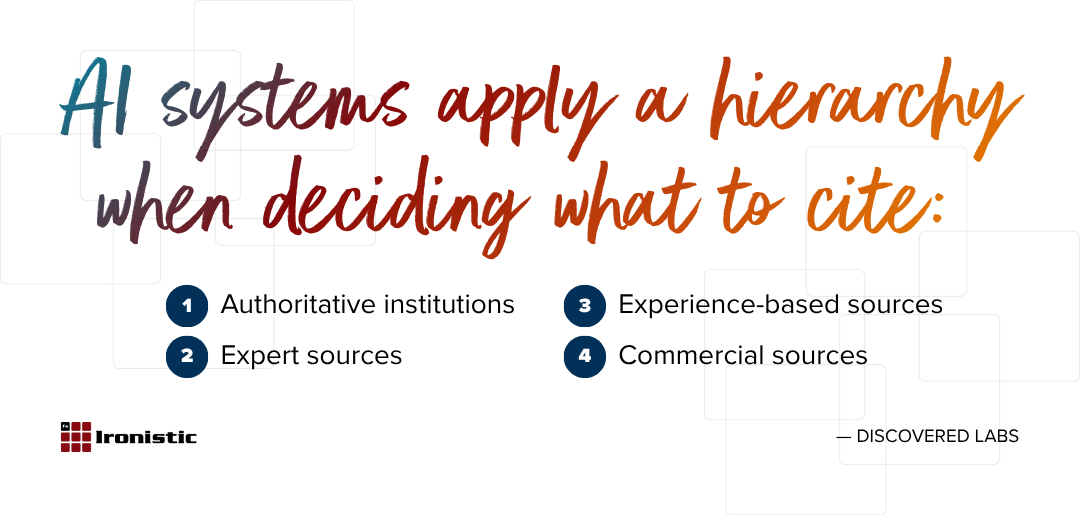
“AI systems apply a hierarchy when deciding what to cite:
- Authoritative institutions
- Expert sources
- Experience-based sources
- Commercial sources”
— Discovered Labs
Our Social Entity & Search Optimization work is built around that last question specifically.
Getting Customer Experience Right
Customer experience is where AI use gets nuanced. A chat tool that answers a repair-hours question at 11 p.m. is genuinely useful. One that pretends to be a person and fumbles a real problem isn’t.
Data backs up why that distinction matters. Eighty-two percent of consumers still want a real person, even when AI gives the exact same answer — a preference that holds from Gen Z all the way to Boomers.
Customer service shows the widest gap of any AI touchpoint tested: About a quarter of consumers like AI there, and more than half don’t.
So the job isn’t replacing the person. It’s clearing the easy stuff — hours, pricing, order status — so a real person is free for the moment a customer really needs one. Those are exactly the details and boundaries our Intelligent Chat Agent Strategy work is built to get right.
None of this AI-in-practice is fringe behavior anymore. Fifty-four percent of small businesses already use AI marketing tools, and that figure is projected to top 80% by the end of the year.³
The businesses figuring this out right now aren’t early adopters. They’re the steady hands working from a solid plan.
Striking a Balance Between AI and Human
 Human-led isn’t a tagline. It’s a specific balance of labor: AI researches, organizes, and even drafts. Humans must chart the course, evaluate what’s true, protect the brand, and decide what goes out the door.
That delineation matters because people notice when it’s missing. More than 8 in 10 consumers say they can spot AI-written content at least some of the time. Images aren’t exempt either. People correctly picked out the AI-generated photo over the real one about 72% of the time when the two were shown side by side.
Today, authenticity pays even more dividends for businesses. It builds consumer trust and brand equity. It’s why real, raw, in-the-moment types of videos can outperform the heavily-polished, studio-quality ones. And it’s why people (and AI search tools) are gravitating toward social communities.
Researchers who analyzed how ChatGPT, Gemini, and Google’s AI Overviews pull their answers found those systems rank real users sharing authentic experiences on platforms like Reddit above commercial sources, precisely because that content reads as human and experience-rich instead of polished.
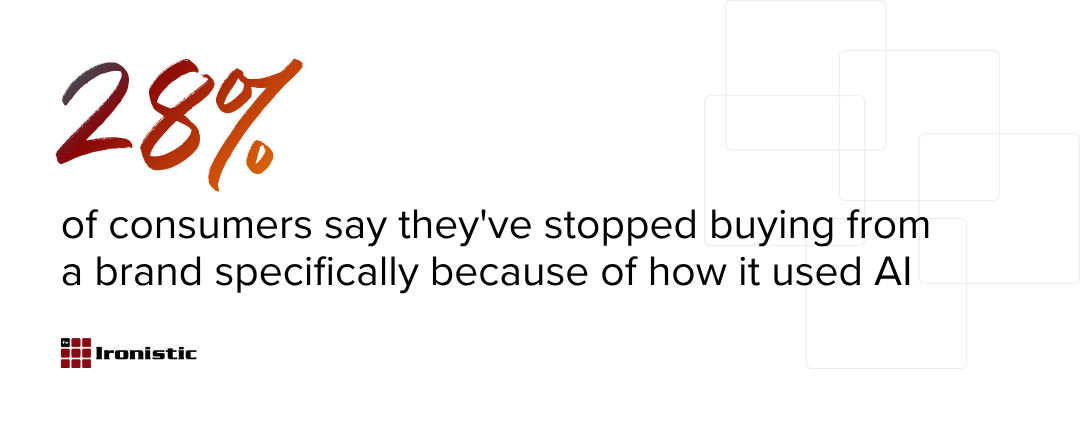
People want to know, without a doubt, that real, human effort went into what they’re reading, seeing, and experiencing. In fact, 28% of consumers say they’ve stopped buying from a brand specifically because of how it used AI,² and a separate study found that once people flag content as AI-written, roughly 40% judge the brand behind it harshly.
Brands like Duolingo have built entire audiences on this exact idea — rough, funny, unmistakably human social content that a scripted campaign could never fake.
The lesson is: You can let AI be an engine, but you can’t give it the wheel. The parts a customer can feel — the tone, the timing, the judgment call — those are exactly the parts worth keeping human.
Where Human-Led AI Begins
In practice, human-led AI usually starts in one of three places.
The first is a straightforward look at where AI could help, and just as important, where it shouldn’t. An AI Readiness Audit does that work before any tool gets purchased, mapping workflows, data, and goals instead of guessing.
For businesses further along, that often pairs with a more technical pass — checking things like llms.txt, schema markup, and the site-level signals AI systems read. That’s where our Technical AI Readiness work picks up.
The second is making sure a business shows up when someone asks an AI platform the exact question it’s built to answer. AEO & LLM Search Optimization takes the same expertise that used to go into ranking on Google and applies it to ChatGPT, Perplexity, and Google’s AI Overviews.
The third is a clear standard for what AI should and shouldn’t touch, so decisions don’t rest on whoever happens to be experimenting that week. Picture a regional accounting firm that let each department test its own AI tools for six months.
By the time anyone compared notes, three teams had landed on three different tones, two had already published outdated guidance, and nobody could say who’d approved any of it. AI Governance & Brand Voice Guidance is the fix — one documented standard that everyone, human or AI, gets checked against.
Build the Strategy the Other 95% Skipped
A measured approach costs a little time up front. But it protects a brand’s voice, its customers, and the foundation that took years to build — the small things that tell your audience they’re still talking to the business they trust, not a robot wearing your logo.
That trade-off isn’t close.
Working with us starts the same way every time: an honest read on where AI helps and where it doesn’t, a plan built around a specific business instead of a generic playbook, and a team that sticks around past the kickoff call.
The result is a sharper strategy, stronger visibility in AI search, faster workflows, and a brand that still sounds like itself at the end of it — not just speed for speed’s sake.
If you’re ready to figure out where AI fits your business, that’s the exact conversation our AI Strategic Consulting Services team has every day.
Let’s build an AI strategy that puts your business squarely in the driver’s seat. Fill out the form below to get the conversation started. 👇