Simple, Sustainable Facebook & Instagram Ad Strategies
for Small Business
Discover proven Facebook and Instagram ad strategies for small and mid-sized businesses — from goals and targeting to budget and…
Read More

Is your website working as hard as it should be… or simply existing?
When rankings dip, traffic plateaus, or conversions feel sluggish, many organizations assume they need “more SEO.” But the real answer is simpler and far more effective: Start with an SEO audit.
SEO site audits set the stage for strong, long-term search performance (versus only short-term gains). They give you a clear, objective look at what’s helping or hurting your visibility and authority, uncovering technical SEO issues, content gaps, keyword opportunities, and much more.
In today’s search landscape — where AI Overviews, changing algorithms, and new ranking signals evolve constantly — an audit isn’t a nice-to-have or a “when I get to it” task. It’s an absolute must.
At Ironistic, our SEO audit services are comprehensive and backed by experts. We blend traditional Search Engine Optimization (SEO) with Answer Engine Optimization (AEO) best practices, ensuring your site is optimized not just for search engines but for AI-driven search experiences as well. Think of it as a tune-up for your website and how it communicates across the entire search ecosystem.
So, if you want more visibility, better rankings, and stronger performance, this is where it starts.
SEO (Search Engine Optimization) is the practice of making your website easier for search engines (and now AI systems) to find, understand, and recommend. In simpler terms, SEO helps your site show up when people are searching for what you offer.
It’s a mix of optimizing your content, structure, code, speed, usability, and authority so your pages can rank well for relevant search terms.
Modern SEO isn’t just about keywords or metadata. It’s about aligning your site with the signals search engines use today: expertise, relevance, user intent, high-quality content, technical health, and helpful user experiences.
Even with constant algorithm changes, new AI search experiences, and a flood of digital marketing tools, SEO remains one of the most effective and cost-efficient ways to grow your online presence.
The way search works has evolved, but the importance of showing up where your audience is looking hasn’t changed. If anything, it’s become more critical.
In short: SEO isn’t an outdated checkbox. It’s a foundational piece of your digital strategy, one that gets stronger the more consistently you nurture and invest in it.
An SEO website audit is a comprehensive evaluation of your website’s search performance, designed to uncover what’s working, what’s holding you back, and where the strongest opportunities lie. Think of it as a full diagnostic check — the data-driven roadmap that shows you how to improve rankings, visibility, and overall site health.
 Instead of guessing why traffic is down or why certain pages aren’t ranking, an SEO audit gives you clear, objective answers. It examines the technical foundation of your site, your on-page content, keyword targeting, internal links, authority signals, user experience factors, and how well your site aligns with modern search and AI-driven expectations.
In other words, an SEO audit shows you exactly where your website is performing well and exactly where it’s quietly leaking traffic, authority, or conversions.
With our SEO audit services, you’ll get an in-depth report on your website’s performance and specific recommendations on how to improve it. Putting those insights into action gives your site the guidance it needs to show up, stand out, and perform the way it should — no guesswork, no wasted effort.
Remember that no websites are the same. There is no universal fit for SEO. Every website has its own specific needs, which is why we start with a site crawl to first find out what we’re working with.
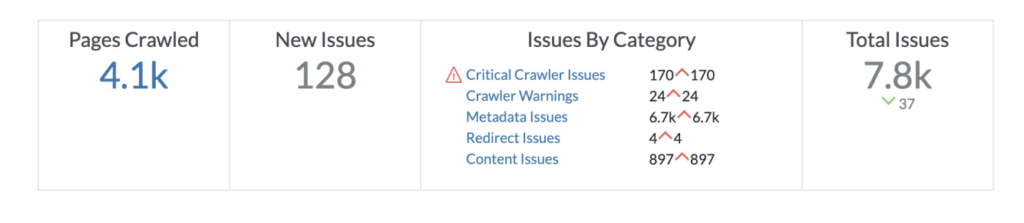
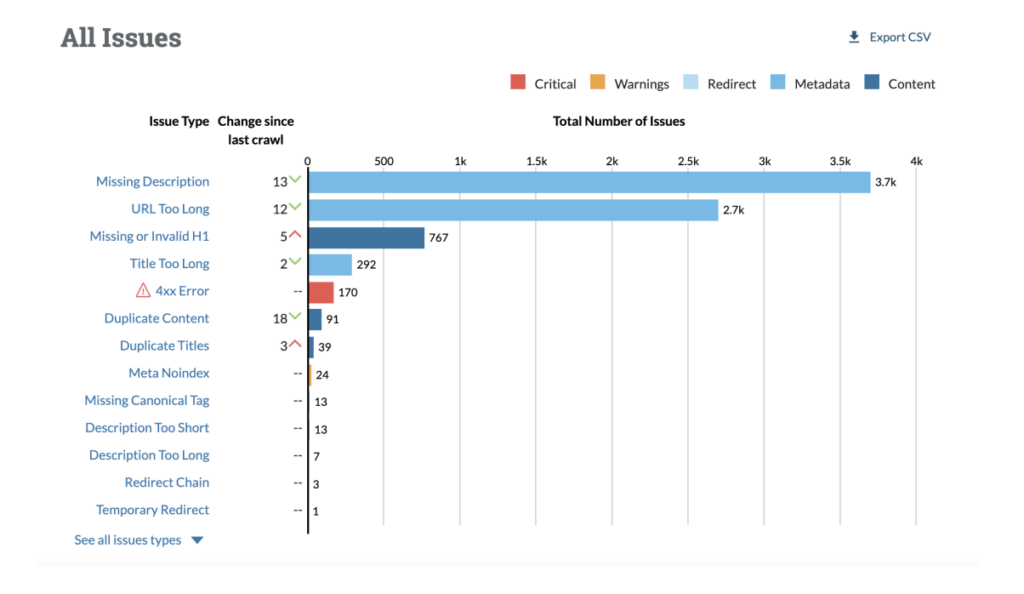
A site crawl is foundational for an SEO audit. It shines a light into every nook and cranny of your website to find hidden problems that may be hindering your website’s performance. This comprehensive overview reveals areas where your website may be falling short and what needs immediate action.
During your audit, we use tools such as Moz (shown in the examples below), Semrush, and Google to identify:
We also review page speed and Core Web Vitals at a high level since slow load times and poor responsiveness can heavily impact search visibility and AEO performance.
With the information gathered from the site crawl, our SEO experts can create a step-by-step plan to optimize your SEO and improve your site’s overall rankings in both traditional search results and generative search/AI-driven surfaces.
Domain authority is another key metric in determining your website’s ranking potential. It measures the strength and credibility of your website’s domain name on a scale of 1-100.
High domain authority is a sign that search engines see your website as a trustworthy and reliable source of information. The higher the domain authority, the better the chance your website will rank on the first page of search engine results – and beat the competition.
During an SEO audit, we analyze your website’s domain authority and identify strategies to improve it. These strategies may include:
Ultimately, improving your domain authority will lead to higher search engine rankings and increased visibility, bringing more of the right visitors to your site.
Keywords and keyword optimization are usually one of the first things people learn about with SEO. But SEO is about more than just throwing up a bunch of keywords and hoping for the best. It’s about using strategic, intent-driven, well-placed keywords that help both search engines and users understand your content.
Keyword analysis is a fundamental aspect of any SEO audit. It involves analyzing the keywords that your website currently ranks for and identifying opportunities to optimize or expand your content to improve your rankings.
By understanding the terms your target audience is searching for, you can create content that better meets their needs and attracts more qualified traffic.
Keyword volume and keyword difficulty are two important metrics used in SEO audits to determine the effectiveness of keyword targeting. Keyword volume measures how often a term is searched each month, while keyword difficulty measures how competitive that term is among other sites..
While high keyword volume indicates a popular search term and greater potential traffic, it often comes with stiff competition. This is where keyword difficulty scores help identify realistic, high-opportunity terms that still generate traffic. Balancing both relevance, search volume, and ranking potential is critical in a successful SEO optimization.
For our SEO audit services, we use tools like Google Analytics, Google Search Console, and Semrush to identify the keywords a site is currently ranking for, where there are competitive gaps, and where new opportunities lie. From there, we can identify areas where content can be improved and pages can be better optimized to drive more targeted traffic to your site.
On-page SEO refers to the process of optimizing individual pages of your website to improve their visibility in search engine results pages.
An On-Page SEO checklist could include:
We’ll also evaluate on-page structure for AEO (Answer Engine Optimization), ensuring key pages answer user questions clearly, concisely, and in formats that AI systems prefer.
Off-page SEO refers to the process of improving your website’s visibility and authority through external factors such as backlinks, mentions, online directories, reviews, and your broader digital reputation.
During an audit, we assess:
Off-page SEO remains one of the strongest indicators of authority, and a high-quality audit will show you exactly where you stand and where you can strengthen your presence.
Much like technical audits, an SEO audit is not a one-time task. As SEO continues to evolve and AEO (Answer Engine Optimization) plays a larger role in visibility, regular audits ensure your site continues to perform at its highest potential.
The first audit is the most comprehensive. Once core issues are resolved, ongoing audits help maintain technical health, adapt to algorithm changes, and surface new opportunities based on user behavior and competitive shifts.
By addressing these issues and capitalizing on hidden opportunities, your website SEO can increase rankings, strengthen visibility, drive higher-quality organic traffic, and maintain a competitive edge in your market.
If you’re ready to elevate your site’s performance, our team is here to help. Ironistic’s expert-driven SEO audit services deliver clear insights, actionable recommendations, and a roadmap designed to strengthen your presence across both search engines and AI-powered experiences. Let’s improve your SEO.