

This blog pulls from a recent Ironistic PPC workshop with our paid media specialists Jon DeNunzio and Firas Zarif.
Paid ads sometimes get treated like a light switch. Pick a platform. Add budget. Flip the switch. Wait for leads.
Easy enough, right?
Not quite.
A person searching Google for “emergency plumber near me” is in a very different mindset than someone scrolling Instagram, watching YouTube, checking Gmail, or browsing LinkedIn between meetings.
That is why the “best” PPC channel depends on what you are advertising, who you are trying to reach, how soon they are likely to act, and how that audience uses each platform.
Quick Answer: What Is the Best PPC Channel?
There is no single best PPC channel for every business. The best channel depends on your goal, audience, budget, offer, and sales cycle.
As a general guide:
- Google Search Ads work well for high-intent searches.
- Google Display Ads are better for awareness and remarketing.
- YouTube Ads support awareness, education, and visual storytelling.
- Demand Gen Ads can help with visual campaigns across YouTube, Discover, Gmail, and Google-connected placements.
- Performance Max can work well for shopping and data-rich accounts, but it gives Google more control across channels.
- Google Shopping Ads are a strong fit for e-commerce products.
- Meta Ads are useful for B2C, e-commerce, remarketing, and offers.
- LinkedIn Ads are often useful for B2B targeting by job title, industry, location, company size, and other professional criteria.
- Microsoft Ads can extend a strong Google Search campaign into another search network.
PPC Channel Guide: Which Paid Ad Platform Fits the Job?
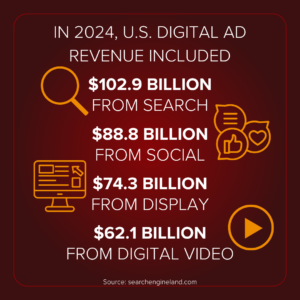 In 2024, U.S. digital ad revenue included $102.9 billion from search, $88.8 billion from social, $74.3 billion from display, and $62.1 billion from digital video.
And with AI Overviews and zero-click results making organic visibility harder to count on, this marketing channel will likely grow even more.
However, more ad spend doesn’t necessarily mean better ad strategy. Here’s how our PPC experts recommend thinking about the major channels.
Google Search Ads
Google Search Ads appear in search results when someone types in a relevant query. You choose keywords, write ads, set budgets and bidding rules, and pay when someone clicks.
Our PPC experts recommend search ads for service-based businesses, local searches, B2B lead generation, and bottom-of-funnel campaigns.
These ads are good fit when:
- People already search for the product or service
- The campaign has strong keyword opportunities
- The offer is clear
- The landing page matches what the person searched
- The budget can support enough clicks to learn
The caution is intent quality. B2B keywords can blur the line between research and buying intent, so keyword strategy, negative keywords, and landing page alignment definitely matter.
Google Display Ads
Google Display Ads place visual ads across websites, apps, and other placements in Google’s Display Network. They can use images, responsive creative, animation, and remarketing audiences.
Our PPC experts recommend Display Ads when:
- You need broad awareness
- You want to retarget site visitors
- You have visual creative ready
- You are measuring reach, visibility, or assisted engagement
- The campaign does not depend on immediate bottom-of-funnel intent
The caution is traffic quality. Display clicks can be cheap, but cheap does not always mean useful. If the goal is direct lead generation or a high-intent conversion, Search may be a stronger first move.
YouTube Ads
Demand Gen Ads
Demand Gen campaigns place visual ads across Google-connected surfaces like YouTube, Discover, and Gmail. Instead of relying only on traditional display placements, Demand Gen uses Google’s owned environments and audience signals.
Our PPC experts recommend Demand Gen for visual campaigns, mid-funnel engagement, and brands that want to reach people before they actively search.
These ads are a good fit when:
- You want visual reach beyond standard Display
- You have strong image or video assets
- You want to reach users across Google-owned surfaces
- You have a defined audience
- You are testing mid-funnel engagement
The caution is expectation setting. Demand Gen can bring in more useful traffic than standard Display, but it is not always a direct conversion machine. The campaign goal and measurement plan need to match the channel.
Performance Max
Performance Max is a Google campaign type that can run across multiple Google placements from one campaign, including Search, Display, YouTube, Gmail, Discover, Maps, and Shopping.
Instead of managing each placement separately, you give Google assets, goals, audience signals, and conversion data.
Our PPC experts recommend Performance Max for shopping, e-commerce, cross-channel reach, and data-rich accounts.
These ads are a good fit when:
- You have strong conversion tracking
- You can feed Google useful audience data
- You have strong creative assets
- You are comfortable giving Google more control
The caution is lead quality. Performance Max may lower cost per lead, but lead quality can vary if tracking, audience data, and conversion signals are weak.
Google Shopping Ads
Google Shopping Ads show product listings directly in search results, often with an image, price, store name, and other product details. They are built for shoppers who are comparing options and may be close to buying.
Our PPC experts recommend Shopping Ads for e-commerce brands, retail campaigns, product promotion, and purchase-focused campaigns.
These ads are a good fit when:
- You sell products online
- Your product feed is clean
- Pricing and images are competitive
- You have enough inventory to support campaign segmentation
The caution is feed quality. Product titles, descriptions, images, pricing, categories, and availability all matter before the campaign ever starts spending
Meta Ads
Meta Ads appear across Facebook, Instagram, Messenger, and other Meta placements. They reach people based on interests, behaviors, custom audiences, lookalike audiences, and past engagement.
Our PPC experts recommend Meta Ads for B2C campaigns, e-commerce, offers, remarketing, local promotions, and lookalike audiences.
These ads are a good fit when:
- The campaign has strong creative
- The offer is easy to understand
- You have a consumer-facing audience
- You want to retarget or build lookalike audiences
- You need to earn attention before someone is actively searching
The caution is intent. People are scrolling, not searching, so the creative, offer, and CTA have to earn attention fast.
LinkedIn Ads
 LinkedIn Ads appear in a professional feed and can target users by job title, company size, industry, seniority, location, and other business details.
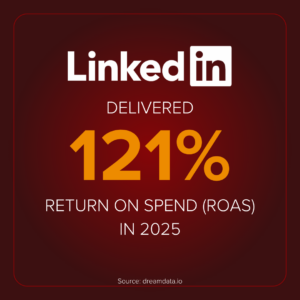
These ads can be highly effective for B2B brands. Dreamdata’s recent 2026 LinkedIn Ads B2B Benchmarks Report found that LinkedIn delivered 121% return on ad spend (ROAS) in 2025. That’s compared to 67% for Google Search and 51% for Meta.
Our PPC experts recommend LinkedIn Ads when:
- You need to reach a defined B2B audience
- The offer has strong business value
- You can afford higher click costs
- The message is tailored to the role or industry
- You have enough budget to collect useful data
The caution is cost. LinkedIn clicks are often expensive, so it is not the place for vague messaging, soft offers, or tiny test budgets.
Microsoft Ads
Microsoft Ads are search ads that run across Microsoft’s network, including Bing. In many cases, successful Google Ads campaigns can be imported into Microsoft and adjusted for budget, volume, and performance expectations.
Our PPC experts note Microsoft Ads as a good fit when:
- Google Search is already performing
- You want additional search reach
- You can adjust budget expectations
- You want to test potentially lower-cost clicks
- You understand volume may be lower than Google
The caution is scale. Microsoft usually will not match Google’s search activity, but it can still add useful traffic when the campaign foundation is already solid.
PPC Channel Cheat Sheet
| PPC Channel | Strongest Use | Best Fit | Watch Out For |
|---|---|---|---|
| Google Search Ads | High-intent search traffic | Service businesses, local searches, B2B lead generation, bottom-of-funnel campaigns | Research intent can look like buying intent, especially in B2B |
| Google Display Ads | Awareness and remarketing | Broad reach, visual ads, retargeting, low-cost visibility | Cheap clicks do not always mean useful traffic |
| YouTube Ads | Video awareness and education | Product demos, service explanations, visual brands, retargeting | Weak hooks get skipped fast |
| Demand Gen Ads | Visual mid-funnel engagement | YouTube, Discover, Gmail, and Google-connected placements | It may not perform like a direct conversion channel |
| Performance Max | Shopping, e-commerce, and cross-channel reach | Data-rich accounts with strong audience and conversion signals | Google gets more control; lead quality can vary |
| Google Shopping Ads | Product visibility and sales | E-commerce, retail, product promotion, purchase-focused campaigns | Feed quality affects performance before ads ever run |
| Meta Ads | B2C, e-commerce, offers, and remarketing | Strong creative, clear offers, consumer audiences, lookalikes | People are scrolling, not actively searching |
| LinkedIn Ads | B2B audience targeting | High-value offers, professional audiences, role- or industry-specific campaigns | Clicks can be expensive, so weak offers struggle |
| Microsoft Ads | Search expansion | Campaigns that already perform well on Google Search | Lower volume than Google |
FAQs About PPC Channels
What is the best PPC channel?
The best PPC channel depends on your goal, audience, budget, offer, and sales cycle. Google Search is often best for high-intent searches. Meta can work well for B2C, e-commerce, offers, and remarketing. LinkedIn is often useful for B2B targeting. Performance Max and Shopping can be strong for e-commerce and data-rich accounts.
Are Google Ads better than Meta Ads?
Google Ads and Meta Ads serve different purposes. Google is often stronger for search intent, while Meta is often stronger for visual offers, remarketing, and consumer campaigns.
Are LinkedIn Ads worth the cost?
LinkedIn Ads can be worth the cost for B2B campaigns with a clear audience and high-value offer.
Is Performance Max good for lead generation?
Performance Max can work for lead generation, but it is often a stronger fit for shopping, e-commerce, and data-rich accounts.
Which PPC channel is best for B2B marketing?
Google Search and LinkedIn are often strong B2B PPC channels. Google Search can capture people actively researching a service or solution. LinkedIn can reach specific professional audiences by job title, industry, company size, seniority, and location. Microsoft Ads may also work as a search expansion channel when Google Search is already performing.
Which PPC channel is best for e-commerce?
Google Shopping, Performance Max, Meta Ads, and Google Search can all support e-commerce campaigns. Shopping and Performance Max are often strong fits for product visibility and sales. Meta can help with visual offers, remarketing, and lookalike audiences. Search can work well when shoppers are actively looking for a specific product or category.
Ready to Figure Out Where Your Paid Ads Should Live?
 The best PPC channel is not the one someone saw in a webinar, heard about from a competitor, or read was “hot” this year.
The right channel depends on what you are promoting, who you need to reach, how they search or browse, and what action you want them to take.
Google Search, Meta, LinkedIn, YouTube, Display, Demand Gen, Performance Max, Shopping, and Microsoft Ads can all play a role. The key is knowing what each channel does best and where your budget will likely earn its keep.
Not sure where your paid ads should live, or how your current channels are performing?
Sync with Ironistic, and we’ll help you map the right PPC strategy from the ground up.
Request a quote or just reach out with your questions below. ⬇️